Nightfall Sound Co. Mind Assembly (Glitch Effect / Mac Only)
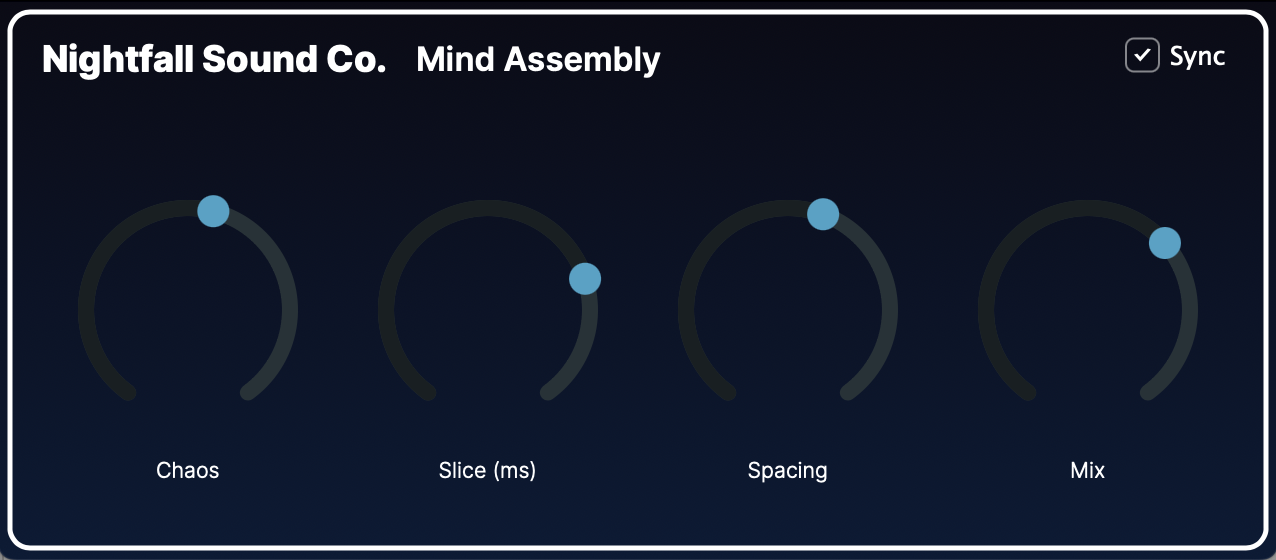
Nightfall Sound Co. Mind Assembly (Glitch Effect / Mac Only)
Nightfall Sound Co. Mind Assembly lives in the moment where sound forgets what it was just doing. Audio is pulled apart, examined, and stitched back together slightly wrong, fragments looping out of order, rhythms forming accidentally or locking tightly to the beat. It doesn’t smooth or correct. It rearranges. The result feels mechanical but unstable, like a machine thinking out loud. Mind Assembly turns that process into an instrument.
Assembly Engine (Primary Process)
Incoming audio is continuously sliced into small fragments and reassembled in real time.
Sound is divided into micro-segments
Fragments are reordered, repeated, or skipped
Rhythmic patterns can drift freely or snap to host tempo
Works equally well on instruments, vocals, drums, and full mixes
Core Controls
Chaos
Introduces unpredictability into how fragments are selected and reordered.
Low values stay patterned and rhythmic. Higher values drift, break, and misfire.Slice (ms)
Sets the size of each fragment.
Short slices create tight, glitchy motion. Longer slices lean toward broken loops and warped rhythm.Spacing
Controls the distance and timing between fragments.
At lower values, fragments cluster and smear. Higher values introduce gaps, stutter, and negative space.Mix
Blends the processed signal with the original input.Sync Mode
When enabled, slicing and spacing lock to the host tempo, allowing Mind Assembly to move with the track — or deliberately against it.
Character
Procedural, not preset-driven
Rhythmic without a rigid grid
Mechanical but imperfect
Designed for sound design, texture creation, and controlled disruption
COMPATIBILITY & SYSTEM REQUIREMENTS (MAC-ONL Y)
Plugin Formats
VST3 (macOS), Audio Units (AU), No AAX / No Pro Tools support, No Windows version
Supported Operating Systems (macOS only)
macOS 10.15 Catalina or later
Fully compatible with:
Apple Silicon (M1/M2/M3) — native ARM64
Intel Macs (x86_64)
Supported Sample Rates
44.1 kHz → 192 kHz
Supported Hosts (macOS)
Ableton Live (VST3 + AU), Logic Pro (AU), FL Studio (VST3), Cubase (VST3), Bitwig (VST3),
Reaper (VST3 + AU), Studio One (VST3)
System Requirements
A Mac running macOS 10.15 or newer
A DAW that supports VST3 or AU plugins
Internet connection required only if you implement activation (optional)
Installation Locations (Unless Otherwise)
AU: /Library/Audio/Plug-Ins/Components/YourPlugin.component
VST3: /Library/Audio/Plug-Ins/VST3/YourPlugin.vst3
Not Supported
Windows, AAX / Pro Tools, 32-bit systems, ARM-based Windows devices
DOWNLOAD COMES WITH VST3, AU & PDF DOC
Why I’m Releasing My Plugins the Way I Am…
I’ve decided to release my plugins the same way a lot of developers I admire do—with trust in the community instead of fear of pirates. I know how this world works: if someone wants to pirate something badly enough, they’ll find a way. That’s been true since the early days of tape machines all the way to modern DAWs. I’d rather spend my energy building tools that inspire people than building walls that only punish the honest users.
My story with music and sound design started long before I ever touched code. I picked up the guitar at 13, and the moment I got my hands on a Tascam PortaStudio, everything changed. That little box blew my world open. It made me fall in love with recording, experimenting, and chasing sounds that didn’t exist yet. As I grew, my setups changed—Cakewalk → Cubase → Studio One → and now Ableton Live—but that feeling never went away. Each stage opened a new door. Eventually I hit a moment where I looked at a simple problem and asked myself, “Could I build this?” I wanted nothing more than a basic amp switcher. That tiny question sent me down a massive rabbit hole.
I found the Beavis Audio Research website and learned everything I could—components, circuits, troubleshooting, all of it. Before long, I wasn’t just building pedals…I was inventing my own effects, tweaking ideas that didn’t exist in the real world. That journey pushed me from analog into digital. I started building effects with the Spin FV-1, turning ideas into code, creating sounds I couldn’t have achieved with hardware alone. And that, eventually, brought me to where I am now—developing plugins. I love it. It’s the perfect blend of audio design, imagination, math, and chaos. And because of that love, I’d rather my plugins be easy to install, easy to use, and easy to share—not locked behind a dozen activation hoops. The people who support my work want to create, not fight with copy protection. So I’ll keep trusting the people who believe in what I’m building.
At the end of the day, this whole thing started because I asked, “Can I build this?” And now I get to hand that same spark of curiosity to other producers, guitarists, sound designers, and weird-sound chasers everywhere. That’s worth more to me than stopping a pirate. If you see my plugins posted somewhere they shouldn’t be-please take action! Thank you all!
© 2025 Nightfall Sound Co. Hypnagogia and all associated artwork, code, and sound design are the intellectual property of Nightfall Sound Co. All rights reserved. Unauthorized copying, distribution, or reverse engineering is strictly prohibited.