Nightfall Sound Co. Hypnagogia (Synth / Mac Only)
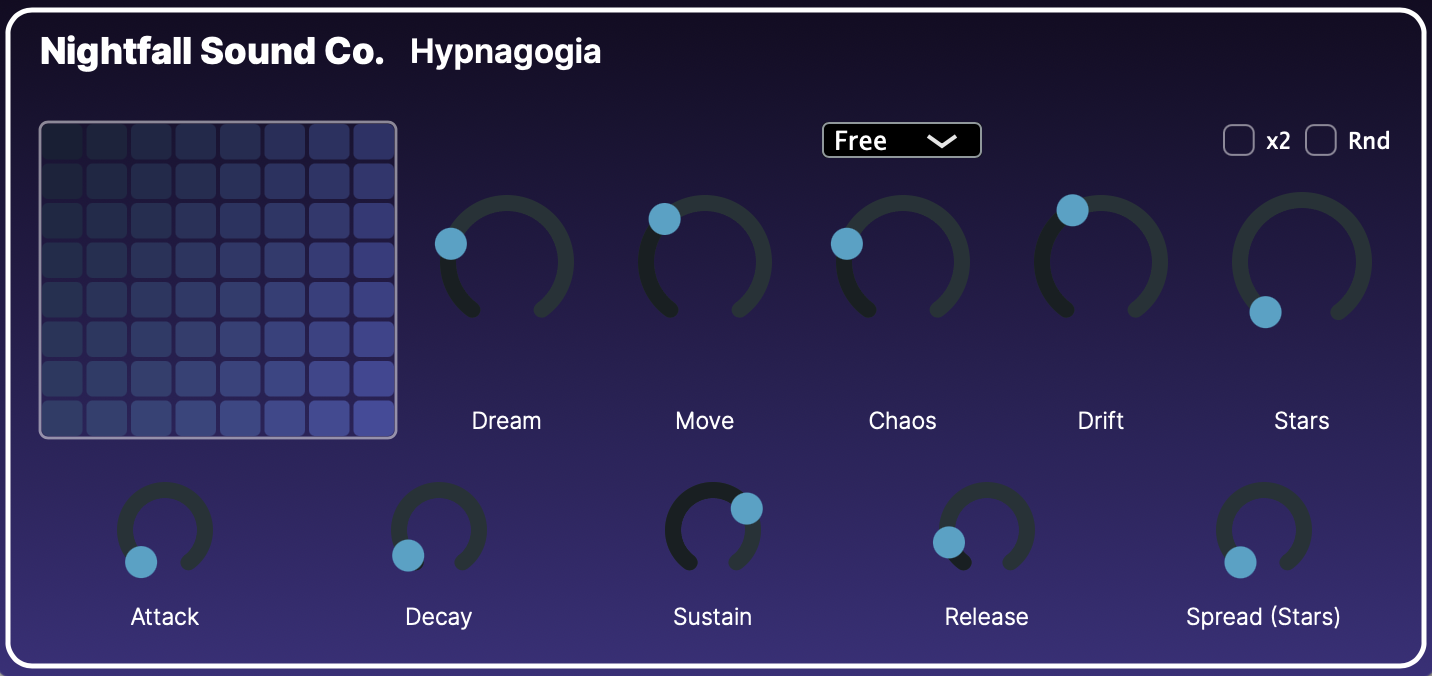
Nightfall Sound Co. Hypnagogia (Synth / Mac Only)
Nightfall Sound Co. Hypnagogia lives in the quiet space between waking and dreaming. A single walker roams a glowing lattice, leaving trails of tone behind it—soft blooms, drifting clusters, unstable harmonics that wander like thoughts just before sleep. Above it, the Stars arp glitters and flutters, throwing little bursts of melody into the haze. The sound sways, wobbles and breathes. It feels found rather than programmed—like discovering the soundtrack that used to play under every forgotten science video, humming through an old CRT in a dark classroom. Hypnagogia turns that feeling into an instrument.
Lattice Engine (Primary Texture Engine)
2D lattice grid defining available positions
Internal walker travels across the lattice
User toggles lattice cells on/off to define the walker’s environment
Walker movement generates the main tone clusters, pads, and motion
Smooth, non-stepwise traversal creates the “old school VHS science tape warm-up” vibe
Walker Controls
Dream – softens or expands the walker’s tonal footprint
Move – speed of lattice traversal
Chaos – adds randomness, jumps, unpredictable routing
Drift – pitch/time instability, wavering, wooziness
Stars Arp Engine (Secondary Layer)
A separate, shimmering melodic/sequenced layer that sits on top of the lattice motion.
Stars Controls
Stars – overall density / how often Stars events fire
Spread (Stars) – stereo/timing distribution of stars
x2 – doubles the arp speed
Rnd – randomizes the star pattern/order
Mode (dropdown) – changes behavior of the Stars engine (Free, etc.)
*Important:
x2, Rnd, and Spread ONLY modify the Stars Arp
They do NOT affect the walker or lattice
Envelope (Global)
Attack – bloom-in of events
Decay – falloff
Sustain – held level
Release – fade-out
Affects the lattice engine events
COMPATIBILITY & SYSTEM REQUIREMENTS (MAC-ONL Y)
Plugin Formats
VST3 (macOS), Audio Units (AU), No AAX / No Pro Tools support, No Windows version
Supported Operating Systems (macOS only)
macOS 10.15 Catalina or later
Fully compatible with:
Apple Silicon (M1/M2/M3) — native ARM64
Intel Macs (x86_64)
Supported Sample Rates
44.1 kHz → 192 kHz
Supported Hosts (macOS)
Ableton Live (VST3 + AU), Logic Pro (AU), FL Studio (VST3), Cubase (VST3), Bitwig (VST3),
Reaper (VST3 + AU), Studio One (VST3)
System Requirements
A Mac running macOS 10.15 or newer
A DAW that supports VST3 or AU plugins
Internet connection required only if you implement activation (optional)
Installation Locations (Unless Otherwise)
AU: /Library/Audio/Plug-Ins/Components/YourPlugin.component
VST3: /Library/Audio/Plug-Ins/VST3/YourPlugin.vst3
Not Supported
Windows, AAX / Pro Tools, 32-bit systems, ARM-based Windows devices
DOWNLOAD COMES WITH VST3, AU & PDF DOC
Why I’m Releasing My Plugins the Way I Am…
I’ve decided to release my plugins the same way a lot of developers I admire do—with trust in the community instead of fear of pirates. I know how this world works: if someone wants to pirate something badly enough, they’ll find a way. That’s been true since the early days of tape machines all the way to modern DAWs. I’d rather spend my energy building tools that inspire people than building walls that only punish the honest users.
My story with music and sound design started long before I ever touched code. I picked up the guitar at 13, and the moment I got my hands on a Tascam PortaStudio, everything changed. That little box blew my world open. It made me fall in love with recording, experimenting, and chasing sounds that didn’t exist yet. As I grew, my setups changed—Cakewalk → Cubase → Studio One → and now Ableton Live—but that feeling never went away. Each stage opened a new door. Eventually I hit a moment where I looked at a simple problem and asked myself, “Could I build this?” I wanted nothing more than a basic amp switcher. That tiny question sent me down a massive rabbit hole.
I found the Beavis Audio Research website and learned everything I could—components, circuits, troubleshooting, all of it. Before long, I wasn’t just building pedals…I was inventing my own effects, tweaking ideas that didn’t exist in the real world. That journey pushed me from analog into digital. I started building effects with the Spin FV-1, turning ideas into code, creating sounds I couldn’t have achieved with hardware alone. And that, eventually, brought me to where I am now—developing plugins. I love it. It’s the perfect blend of audio design, imagination, math, and chaos. And because of that love, I’d rather my plugins be easy to install, easy to use, and easy to share—not locked behind a dozen activation hoops. The people who support my work want to create, not fight with copy protection. So I’ll keep trusting the people who believe in what I’m building.
At the end of the day, this whole thing started because I asked, “Can I build this?” And now I get to hand that same spark of curiosity to other producers, guitarists, sound designers, and weird-sound chasers everywhere. That’s worth more to me than stopping a pirate. If you see my plugins posted somewhere they shouldn’t be-please take action! Thank you all!
© 2025 Nightfall Sound Co. Hypnagogia and all associated artwork, code, and sound design are the intellectual property of Nightfall Sound Co. All rights reserved. Unauthorized copying, distribution, or reverse engineering is strictly prohibited.